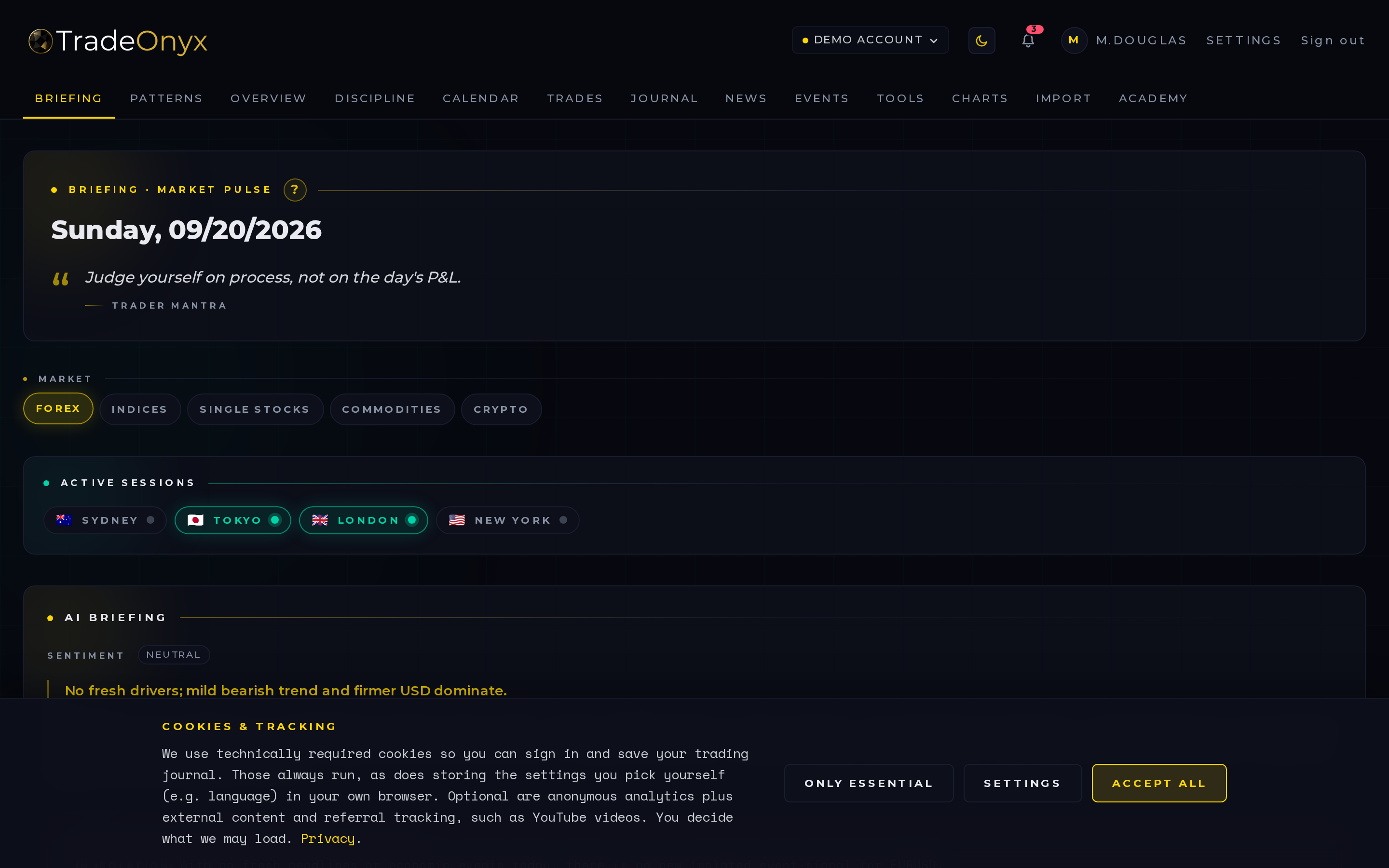
The Briefing tab is where you commit to today before today commits to you. You log the macro context (overnight movers, news ahead), the setups you're hunting, your personal state (sleep, stress, capacity), and a single focus rule for the session ("only A-grade entries", "max 2 trades", "no revenge trades"). Once written, the page is a contract — an artifact you can compare your actual trades against at end-of-day.
The structural value is twofold. First, writing slows you down enough to notice when today is a no-trade day before you've already entered. Second, the briefing acts as a bias check: anything you traded outside your written plan shows up in tomorrow's review as "did I follow my own rules or not?"
What goes on a good briefing:
- Three sentences max for macro — anything longer becomes news-feed noise.
- Specific setups, not vibes — "EURUSD: long break-and-retest of 1.0850" beats "feeling bullish euro."
- Honest mood scale (1-5) — even a 2 is fine. The number is for your future self, not a review board.
- One rule, not seven — the focus rule is a circuit-breaker, not a checklist. You'll only honor one anyway.
- Decision: trade or skip — making the call BEFORE the open prevents the FOMO drift after the open.
The Briefing tab is the cheapest discipline in the dashboard — three minutes a day saves you from the trades you'd otherwise take in the first 30 minutes of doubt. Log the day, set the rule, then close the tab.
In TradeOnyx the Briefing renders alongside an at-a-glance economic-calendar strip (today's high-impact events) and your mood-and-rule-check streak from the last 7 days — so you can see at the moment of writing whether you've drifted on discipline lately. After you save, the page becomes immutable for that date — no rewriting your plan after the fact.
The pairing that makes Briefing work: at end-of-day you re-open it next to the Journal tab and check whether your actual trades matched the morning plan. Trades inside the plan land in green; trades outside it get flagged. Over a few weeks the discipline-drift pattern (or lack of one) becomes obvious without any spreadsheet — that's the Briefing → Journal feedback loop the platform was built around.